
ここから本文です
TWO:"This is the way," another gruff voice said. "He's here for any money."

Hydrocyclone (liquid cyclone)01

Hydrocyclone (liquid cyclone)02

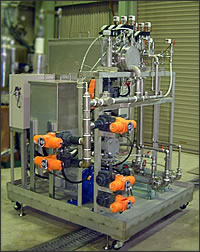
A hydrocyclone (liquid cyclone) injects treatment solution into stationary equipment to perform separation, classification, and concentration, and is an innovative separator with a very simple structure and no drive unit.

Structure of a hydrocyclone (liquid cyclone)

A suspension containing fine particles of several micrometers or more is supplied to a cylindrical container circumferentially at high speed. And as a result it starts to rotate and a centrifugal force is generated. At this time a gravitational acceleration of several tens of thousands of G is generated in the circumferential direction, and thus leading to fast sedimentation and concentration of the fine particles. The separated concentration can be freely selected by changing the supply rate (supply pressure and flow rate) and the flow ratio of the outlet. Our hydrocyclone (liquid cyclone) was designed and manufactured to classify and concentrate fine particles, and so has a small element.

THREE:"I dare say," said Lawrence, drily, "but you didn't know. There would have been another murder on your soul had it not been for my niece. Maitrank was furious. But he was a valuable ally to me, in fact I calculated on that. By his means I forced a confession from you that it was yourself who paid the rest of those notes to Isidore, and this I can prove out of your own mouth, by the production of that tuberose perfume. You were mad and desperate that night to part with the last of your store."The rules for breeding and education set forth in the Republic are not intended for the whole community, but only244 for the ruling minority. It was by the corruption of the higher classes that Plato was most distressed, and the salvation of the State depended, according to him, on their reformation. This leads us on to his scheme for the reconstitution of society. It is intimately connected with his method of logical definition and classification. He shows with great force that the collective action of human beings is conditioned by the division of labour; and argues from this that every individual ought, in the interest of the whole, to be restricted to a single occupation. Therefore, the industrial classes, who form the bulk of the population, are to be excluded both from military service and from political power. The Peloponnesian War had led to a general substitution of professional soldiers for the old levies of untrained citizens in Greek warfare. Plato was deeply impressed by the dangers, as well as by the advantages, of this revolution. That each profession should be exercised only by persons trained for it, suited his notions alike as a logician, a teacher, and a practical reformer. But he saw that mercenary fighters might use their power to oppress and plunder the defenceless citizens, or to establish a military despotism. And, holding that government should, like strategy, be exercised only by functionaries naturally fitted and expressly trained for the work, he saw equally that a privileged class would be tempted to abuse their position in order to fill their pockets and to gratify their passions. He proposed to provide against these dangers, first by the new system of education already described, and secondly by pushing the division of labour to its logical conclusion. That they might the better attend to their specific duties, the defenders and the rulers of the State were not to practise the art of money-making; in other words, they were not to possess any property of their own, but were to be supported by the labour of the industrial classes. Furthermore, that they need not quarrel among themselves, he proposed that every private interest should be eliminated245 from their lives, and that they should, as a class, be united by the closest bonds of family affection. This purpose was to be effected by the abolition of marriage and of domesticity. The couples chosen for breeding were to be separated when the object of their union had been attained; children were to be taken from their mothers immediately after birth and brought up at the expense and under the supervision of the State. Sickly and deformed infants were to be destroyed. Those who fell short of the aristocratic standard were to be degraded, and their places filled up by the exceptionally gifted offspring of low-class parents. Members of the military and governing caste were to address each other according to the kinship which might possibly exist between them. In the absence of home-employments, women were to be, so far as possible, assimilated to men; to pass through the same bodily and mental training; to be enrolled in the army; and, if they showed the necessary capacity, to discharge the highest political functions. In this practical dialectic the identifying no less than the differentiating power of logic is displayed, and displayed also in defiance of common ideas, as in the modern classifications of zoology and botany. Plato introduces distinctions where they did not before exist, and annuls those which were already recognised. The sexes were to be assimilated, political life was to be identified with family life, and the whole community was to present an exact parallel with the individual soul. The ruling committee corresponded to reason, the army to passionate spirit, and the industrial classes to the animal desires; and each, in its perfect constitution, represented one of the cardinal virtues as reinterpreted by Plato. Wisdom belonged to the ruling part, courage to the intermediate executive power, and temperance or obedience to the organs of material existence; while justice meant the general harmony resulting from the fulfilment of their appropriate functions by all. We may add that the whole State reproduced the Greek family in a much246 deeper sense than Plato himself was aware of. For his aristocracy represents the man, whose virtue, in the words of Gorgias, was to administer the State; and his industrial class takes the place of the woman, whose duty was to order her house, and keep what is indoors, and obey her husband.146
  • Equipment costs can be reduced.
  • Operating costs can be reduced.
  • Maintenance costs can be reduced.
  • Any change in raw material and product can be easily addressed.
  • Large amounts can be treated in a small area.
  • Separation and cleaning are easy because of the simple structure.
  • Simplified control
  • This equipment can be operated in synchronization with external devices.
  • Alarm and interlock mechanism.
THREE:
  • Classification and concentration for the manufacture of inorganic powder materials
  • Classification of ceramic materials
  • Removal of fine particles, including iron powder
  • Removal of fine particles from pigments
  • Removal of fine organic particles from solvents
  • Separation of starch and yeast
  • Removal of fine particles from high-temperature strong acid solutions
  • Removal of fine particles from low-temperature solutions